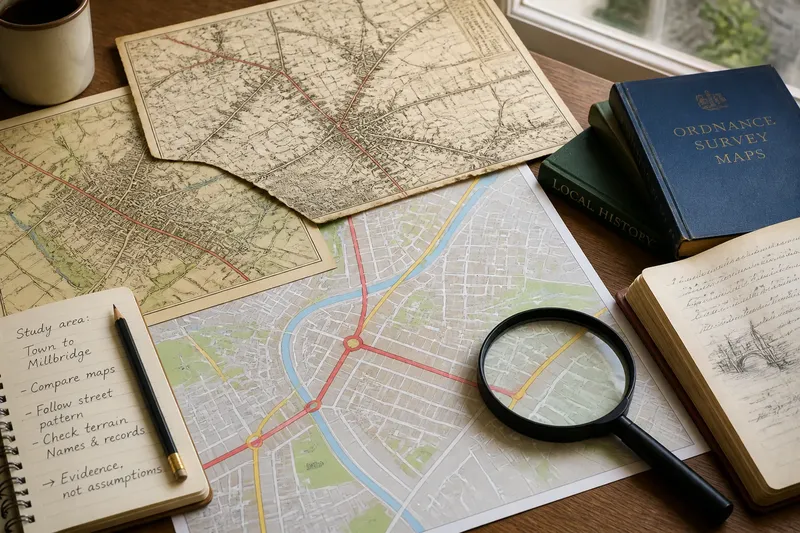
A Place Name, Read with Care
A place name, read with care: separate its written form, possible history and present use to avoid turning a plausible origin into a settled fact.
A place name, read with care, begins as a word on a sign, not a solved riddle. Its spelling, possible history and present use are different kinds of evidence; keeping them apart makes an unfamiliar name easier to understand without pretending that one explanation must be final.
Start with the written form
Copy the name exactly as it appears in the place you encountered it. Preserve accents, apostrophes, hyphens, spaces and unusual capitalization. A map label, a road sign and a local notice may spell the same name differently, and those differences can matter.
Record where the spelling came from. “On a transit map” is more useful than “the official spelling” if you have not checked who issued it. A map may shorten a name to fit; a sign may reflect a local convention; a search result may have dropped a diacritic somewhere along the way.
Then separate what you can see from what you infer. You can say that a name contains two visible elements or that its spelling resembles a word in another language. You cannot yet say that those elements explain its origin. Written resemblance is a clue, not a family tree.
Think of the spelling as a label on a jar: it tells you what is written there, not everything that went into it. This plain distinction prevents a tidy-looking word from becoming a tidy-looking story.
Keep sound in view
Pronunciation can clarify a spelling, but it should not be treated as a correction. Ask how residents say the name, if you can do so naturally, and note which part is stressed. The local pronunciation may preserve a sound that standard spelling hides, or it may differ from what a visitor expects.
Do not assume that a familiar-looking name follows the pronunciation rules of your own language. Nor should an unfamiliar sound be “fixed” to make it easier to say. A careful note can record both forms: the spelling on the sign and the pronunciation you heard, with the setting made clear.
Pronunciation also varies among speakers. Someone who grew up nearby, a recent resident and a person reading aloud from a map may not use the same form. That variation is information about present use, not a reason to appoint one speaker as the final authority.
Ask history modestly
A place name may reflect a language once spoken locally, a landscape feature, a person, a settlement, or a later administrative choice. More than one process can leave a mark. A name can also change its spelling or meaning as people carry it from one language or institution into another.
When considering an origin, look for evidence that connects the proposed explanation to this particular place. Local language guides, place-name records, maps from different periods and municipal material may offer useful clues. A dictionary entry can explain a word without proving that the word produced the name in question.
Notice the limits of each source. A map may show when a form appears in that mapmaker’s record, not when residents first used it. A local account may preserve valuable knowledge while offering one strand of a more complicated history. Keep the source beside the claim rather than letting the claim travel alone.
Use language that matches the evidence. “May derive from” or “is sometimes explained as” leaves room for uncertainty. “Means” is stronger: reserve it for a meaning that is well supported in the relevant context, rather than for an attractive translation found in isolation.
Watch present use
The name’s current life may matter more to a visitor than its oldest recoverable form. It might identify a neighborhood, a station, a hill, a community or a wider area, and those uses need not share the same edges. Check what the name points to in the setting where you found it.
Pay attention to who uses the name and for what. Residents may use a shorter form in conversation; a transit operator may use a formal label; a local organization may use a name that signals community identity. These forms can overlap without being interchangeable in every situation.
Do not infer that a name is accepted by everyone simply because it appears on a map. Where a naming dispute or a sensitive history is relevant, consult local usage and institutional sources with care. Use the term needed for the context, and describe disagreement rather than smoothing it away.
What can a name tell you?
Does a spelling reveal the name’s origin?
It can suggest questions, but spelling alone rarely settles origin. Compare the form with local language resources and records connected to the place before treating a resemblance as evidence.
Should I trust a map’s wording?
A map is useful evidence of how its publisher labels a place. It may not capture every local form or explain the name’s history, so note the map and its purpose.
Why do residents pronounce it differently?
Pronunciation can vary by language, generation, family and circumstance. Record the form you heard and where you heard it instead of treating variation as an error.
What if two explanations seem plausible?
Keep both possibilities visible and state what supports each one. If the available evidence does not distinguish them, say so rather than choosing the more elegant story.
Make a compact field note
A useful note can be brief without collapsing observation and interpretation. Include enough context that another reader can tell what you saw, what you heard and what remains uncertain.
- Written form: copy the spelling and punctuation from the sign, map or document.
- Source: identify where the form appeared, such as a street sign or a local map.
- Pronunciation: record the version you heard and the context, without presenting one speaker as universal.
- Possible history: list a proposed origin only with its source and degree of confidence.
- Current referent: note what the name identifies in that setting, such as a station or neighborhood.
- Open question: mark any spelling, boundary or interpretation you could not resolve.
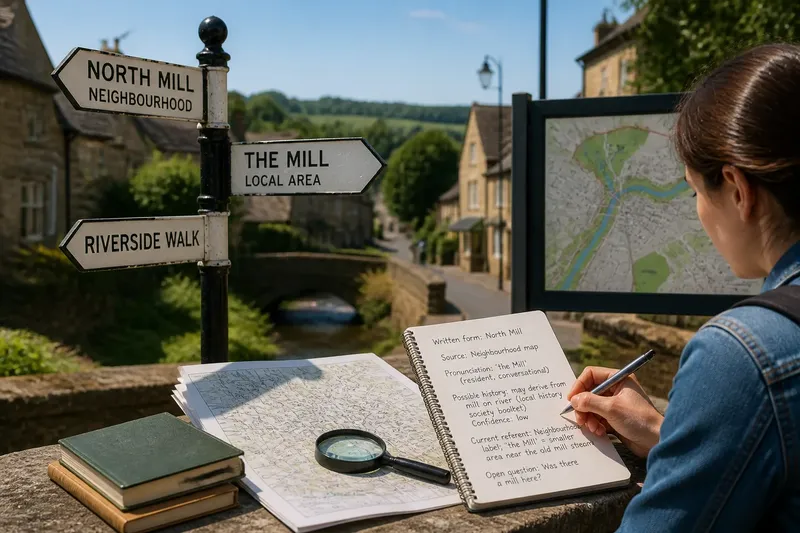
Say you see “North Mill” on a neighborhood map, then hear a resident use “the Mill” for a smaller area nearby. A careful note records both forms, identifies the map as the source of the longer spelling and distinguishes the neighborhood label from the resident’s conversational reference. It does not claim that a mill stood there unless a relevant source supports that separate historical point.
For a place name, read with care means keeping the label, its possible past and its present use in separate lines of thought. That small discipline makes room for local knowledge and for uncertainty alike. When you share the name, include the context that lets others see which part is observed and which part is still a question.